From belt to crate, from case to pallet.
Humanoid robots for the food end of line: they pick packs off the belt, put them into cases and build pallets, at the pace of the packing machine and across shifts.
The processes
Where the work goes uncovered.
-
An end of line that is still manual
Packing machines run fast, but filling crates and cases is often still done by hand.
-
Frequent format changes
Seasons, promotions and new SKUs change the product often: a fixed installation has to be re-tooled every time.
-
Cold rooms and a constant pace
Chilled areas and a relentless cadence are hard conditions for anyone working them a full shift.
Three processes.
One robotic worker.
- 01
Conveyor picking
Picks packs off the conveyor and places them in crates.
It takes each pack as it leaves the packing machine and sets it in the crate following the fill pattern, crate after crate.
Packing machineRobotic worker Picks on the moveCrateProcess diagram Bender simulation · Conveyor picking - 02
Case packing
Puts packed products into cases.
It builds the layer, keeps orientation and count per case and hands the case on to sealing. A format change is a process update, not a re-tooling.
PacksRobotic worker Builds the layerCaseProcess diagram Bender simulation · Case packing - 03
Pallet preparation
Stacks light cases on a pallet following a pattern.
It stacks the cases layer by layer to the planned pallet pattern, ready for wrapping and shipping.
CasesRobotic worker Stacks to patternPalletProcess diagram Bender simulation · Pallet preparation
Feasibility is verified for each process on your site, with the chosen robot, during the free assessment.
From packing machine to warehouse,
no legs required.
A humanoid on a wheeled base takes over the most repetitive end-of-line work. No legs to balance means every watt goes into arms, hands and working hours.
-
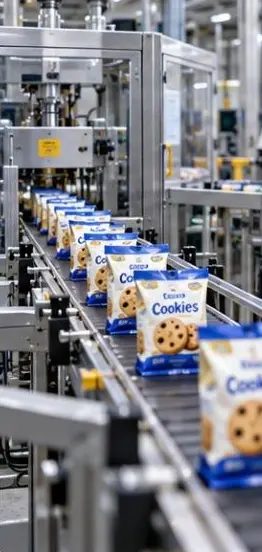 01
01Packed products arrive from the packing machine
The conveyor accumulates packs straight off the packer, at line speed.
-
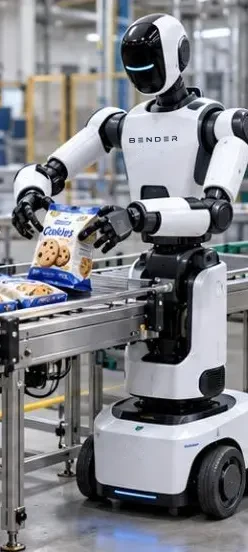 02
02Robot picks products from the conveyor
Vision and two hands: every pack picked in stride, no line retooling.
-
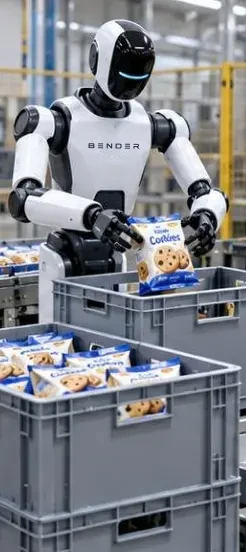 03
03Robot fills crates or carton boxes
The same fill pattern, crate after crate, shift after shift.
-
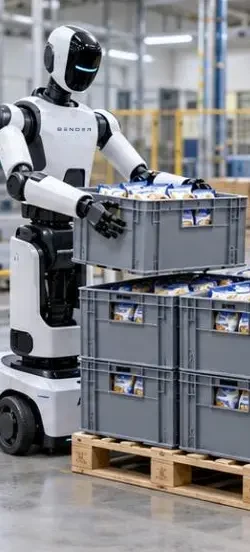 04
04Full crates are stacked onto a pallet
The mobile base carries each crate to the pallet and stacks it in place.
-
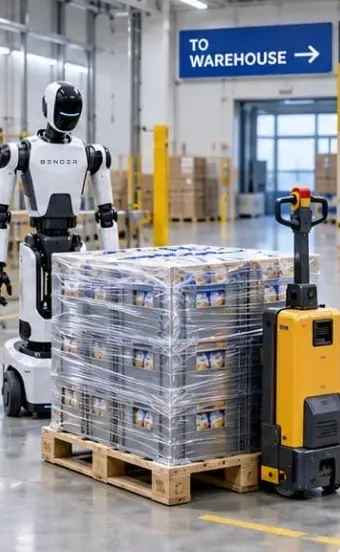 05
05Pallet moves to the warehouse
The robot doesn't clock out — the line can run longer hours.
Illustrative renderings of an AgiBot G2 deployment scenario.
How many more hours?
Line hours covered per week (5 days, 8-hour shifts; 24/7 = 7 days).
- of productive work a year, up to, on 24/7 coverage
- 6,000 h
- full-time people: the equivalent shift capacity
- 3.5–4
- lower cost for the same hours, all-inclusive fee
- ~63%
Indicative figures, verified case by case in the assessment.
You tell us the job. We take care of the robot.
- 01
We select
We pick the right robot for the process across 20+ manufacturers: we have no catalogue to defend.
- 02
We deploy
Delivery, setup, integrations and workflow training, inside your operation.
- 03
We operate
Remote monitoring, updates, maintenance and replacement. You buy productive hours, not hardware.
Food & Beverage, in brief.
Is the robot suitable for food environments?
For each case we assess hygiene, temperature and humidity and choose a suitable robot and protection. Areas in direct contact with unpackaged food have specific requirements, which we verify with you.
How heavy can the cases be?
It depends on the robot chosen, which is why pallet preparation covers light cases. In the assessment we start from your line's real weights and formats.
What work would you give to a robot?
Tell us the task, the environment, the hours you need covered and the result you expect. We'll assess the use case and identify the right robotic worker.